One memory · every MCP client · your own graph
Same context,
every tool you open.
Claude, Cursor and ChatGPT each start from nothing and rebuild your project from scratch. Memoizr keeps it in one private graph they all read from — and write back to, so the next tool opens knowing what the last one decided.
14 days free · no card · your memories stay yours





One memory, one avatar. Every agent you connect reads it and writes back to it.
One endpoint. Every tool you already have open.
- Claude
- Cursor
- Copilot
- Cline
- Windsurf
- Gemini
- Zed
- Warp
- JetBrains
- VS Code · ChatGPT · Codex
the cast
You don't create a database. You create someone.
Every avatar has a character — a manner, a way of answering, and a face. What it knows is your memory; how it tells you is your choice. Pick one now or change it later; either way the memory is the same.
Maya
Assistant
Hello — I keep the notes for your work. Ask me anything that's in them.
I keep track of what you decided, and when.
Maya is the person who takes the notes nobody else remembers to take. She keeps decisions, owners and dates straight, and she is comfortable saying that something was decided one way in March and changed in June.
- How Maya answers
- You open with the answer, then add one sentence of context.
- You give the date whenever a record has one.
- When two records disagree you say which is more recent rather than picking.
- When it isn't in the memory: say plainly that it is not in your notes, without apologising twice.
Things people ask Maya
Any of them can be renamed, and you can change your mind later — the memory stays.
use cases
Where this earns its keep
Six situations that come up in a normal week. None of them need a new tool — they need the tools you have to stop forgetting.
Plan in Claude, build in Cursor
You settle the approach in a chat. Cursor opens already knowing the decisions and the reasons behind them, so it doesn't re-litigate the architecture inside a diff.
Pick up Monday where Friday stopped
The window closed with three things half-decided. Monday's first prompt is "carry on", not four paragraphs of background.
Hand the work to a colleague's agent
Invite them by email and choose read or write. Their agents connect under exactly that permission — and revoking it kills the tokens their agents were using.
Onboard someone without writing a doc
Give a new teammate read access. Their agent answers "why is it done this way" from the same decisions yours wrote down, and cannot change any of them.
Publish an avatar people can ask
A consultant's playbook, a project's conventions. Turn on a public link and anyone's agent can read it. Nobody writes to it unless you say so.
Give a fleet of agents one notebook
A planner, an implementer and a reviewer, each with its own revocable token, all reading and writing one graph instead of three private scratchpads.
Sharing, invites and public links are on the paid plan. Everything else works on Free.
one memory, many tools
The memory sits outside the tools
Every client reads the same graph when it connects and writes back what it learns. Add a tool and it inherits everything the others already know.
Monday. You explain billing-svc to Claude.
Product names and logos are trademarks of their respective owners, shown to indicate compatibility. Memoizr is not affiliated with or endorsed by them.
what it costs you
Every session starts at zero
You brief an agent, it does good work, the window closes, and the understanding goes with it. Tomorrow you type it again — and the agent in your other tool never heard any of it.
You re-type your own project
The same repo, the same constraints, the same decision you already made — pasted in again because a window closed.
Each tool knows a different slice
Claude learned it Monday. Cursor never heard. Neither one can ask the other.
Your team's context is stuck in your chat log
What your colleague's agent worked out last week is invisible to yours, and the only transport is a summary you write by hand.
the difference
Same request. One of them already knows.
This is the whole product in one picture: the work of understanding your project, done once instead of every time.
without a memory
…
memoized
…
An illustration of the interaction, not a benchmark.

A handoff only works if the next runner already knows the race.
Invite a colleague and their agents read the same memory — under exactly the permission you chose, revocable the moment you change your mind.
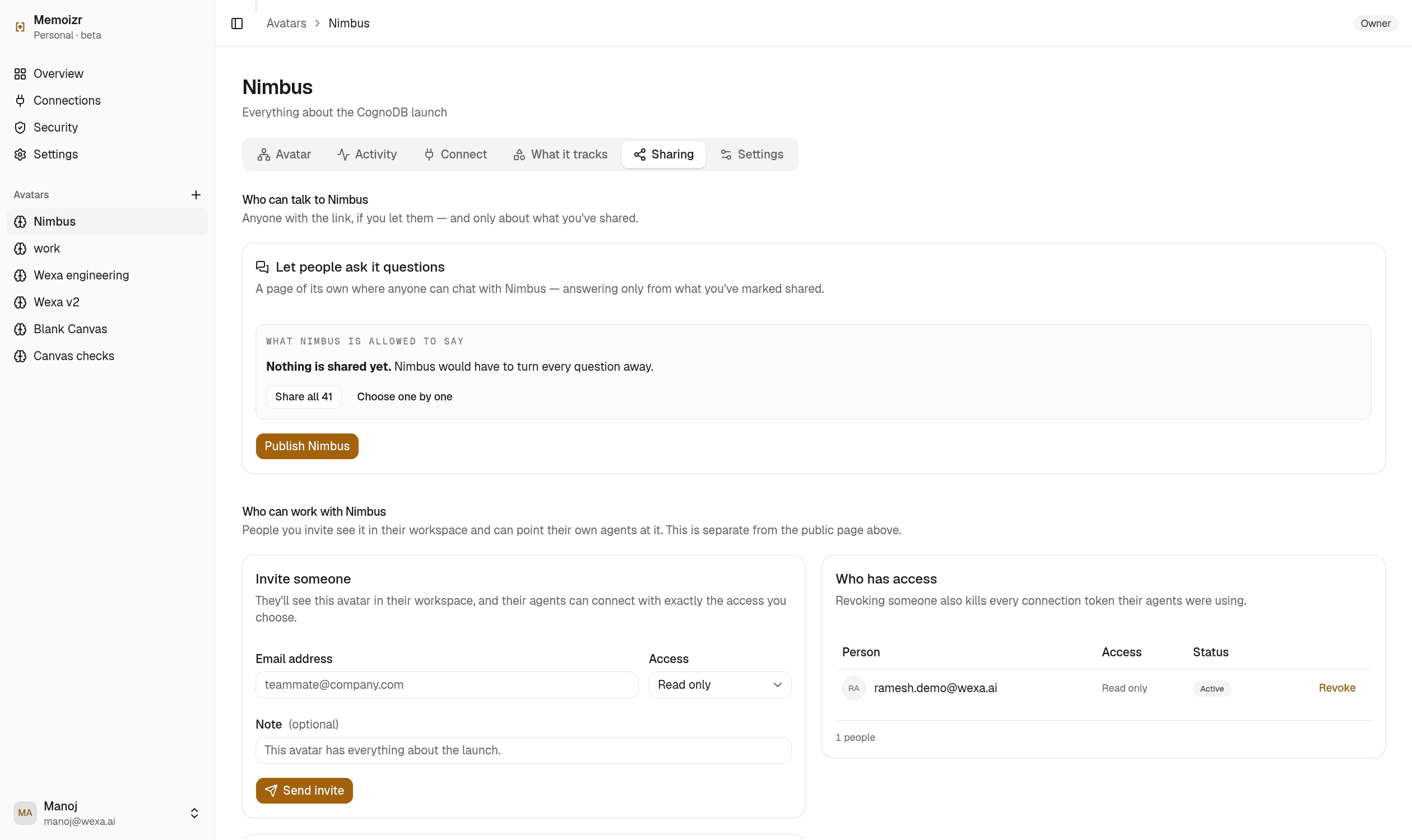
Hand it over
Give your context to someone else's agent
Invite a colleague by email and choose read or write. Their agents connect to the same avatar under exactly that permission, so they start where you left off instead of asking you for a summary.
- Read or write, chosen per person
- Revoke access and their agents' tokens die with it
- A public page when you want people to ask it things
Pick it up
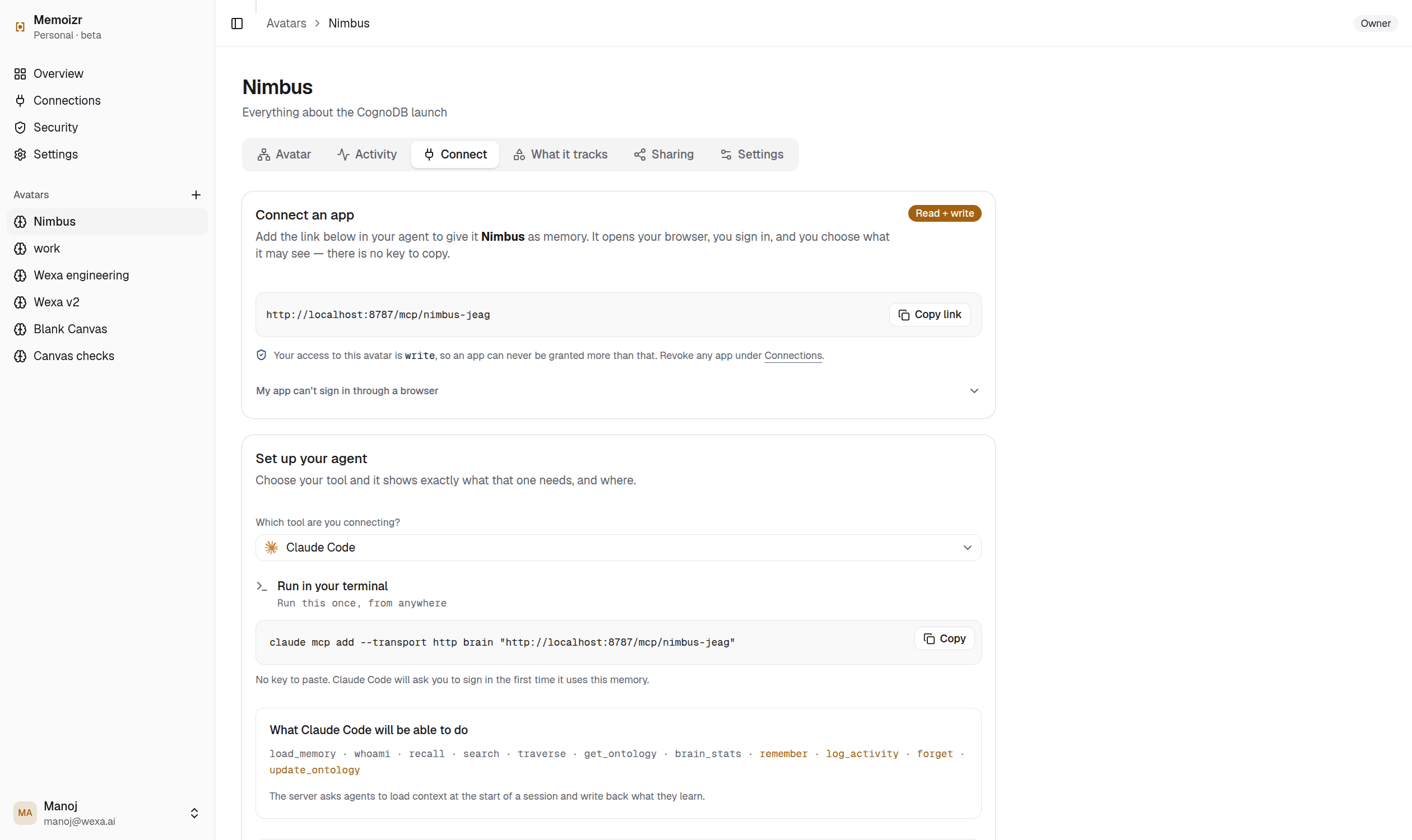
Start in one tool, finish in another
Plan in Claude, implement in Cursor, review in Codex. Each one recalls the same memory the moment it connects, so the second tool already knows what the first decided — including why.
- One endpoint, every MCP client
- Agents write back what they learn as they work
- Activity timeline of every recall and decision
See it
Look at what your agents actually know
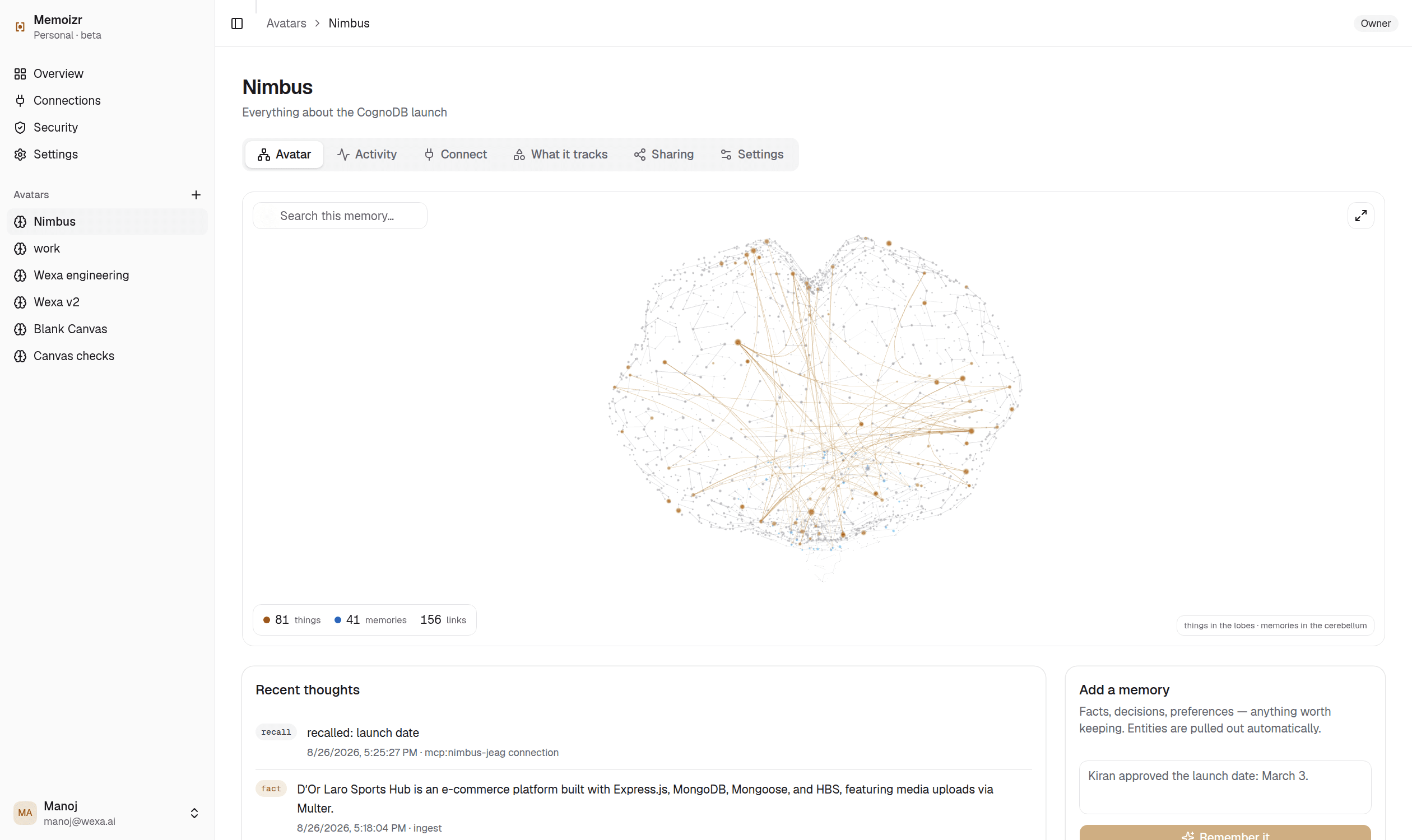
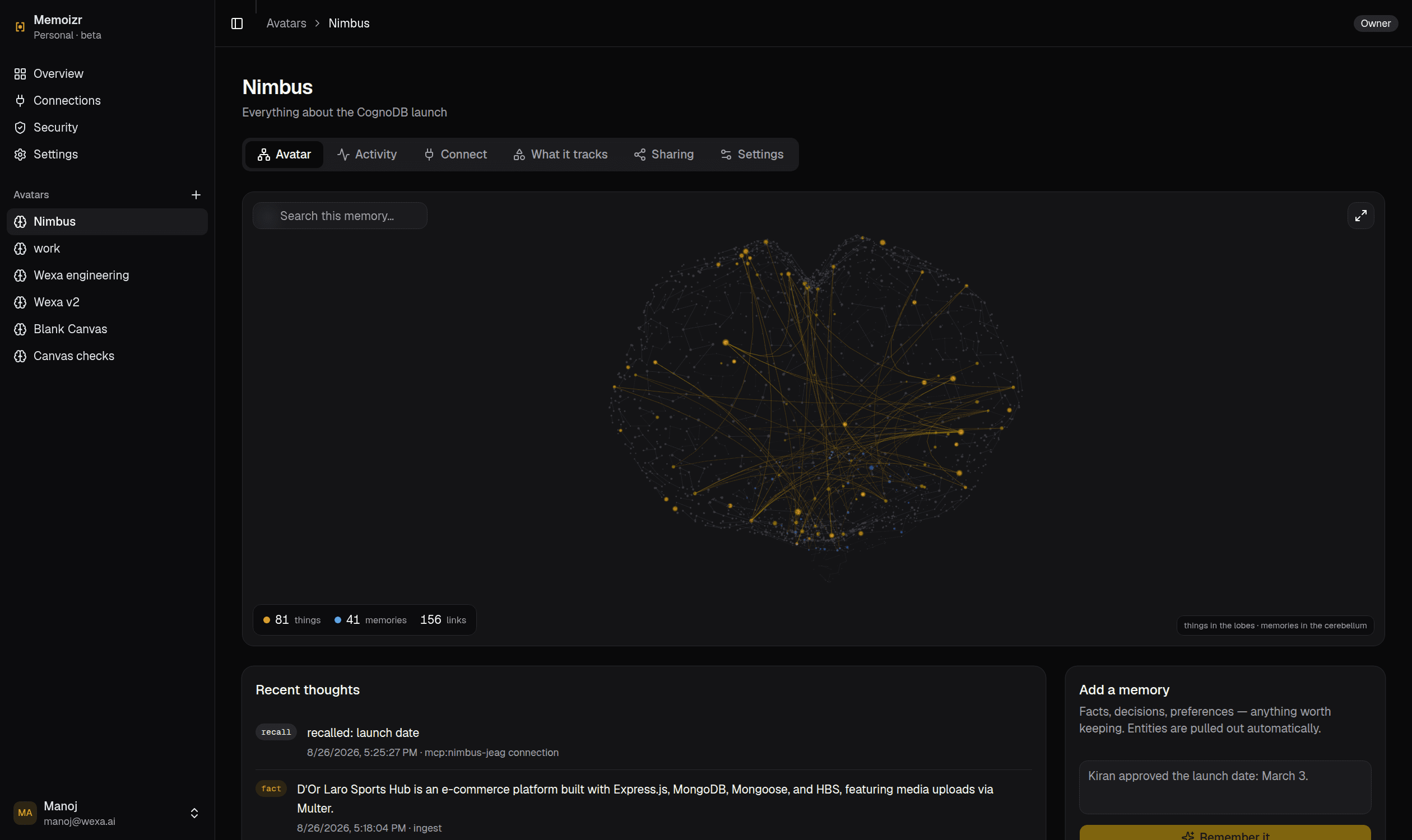
Memory you can't inspect is memory you can't trust. Every fact is a node with its provenance attached, clustered by how it connects, flaring the moment something new lands.
- Click any node to see where it came from
- Search flies the camera to a hit
- Reshape the ontology in plain language
not a database connection
Agents get memory tools, not SQL
There is no raw query tool, which is exactly why the scoping can't be escaped. An agent asks for what it needs and stores what it learns — and the server tells it to do both, so the avatar's memory grows while you work.
recall is hybrid: keyword search, vector similarity and a graph expansion around the hits, returned as compact context.
available to every connected agent
readload_memory
readwhoami
readrecall
readsearch
readtraverse
readget_ontology
readbrain_stats
writeremember
writelog_activity
writeforget
writeupdate_ontology
Read-only connections never see the write tools at all.
how it works
Three steps, in this order
- 01
Name an avatar
It gets its own isolated graph and a memory endpoint. About ten seconds.
- 02
Give it something to know
Just start working — your agents write down what they learn as they go, and read it back the next time you open any of them.
- 03
Paste one line into your agent
Copy the config for Claude, Cursor, VS Code or any MCP client. From then on they all share it.

isolation
An avatar holds everything. So isolation is the product.
Everything below is how it's actually built, not a roadmap.
SOC 2 Type I certifiedSOC 2 Type II in progress
An avatar, not a row in a table
Every avatar is a separately-permissioned graph with its own credentials path. On the paid plan your memories are isolated to your account alone; on the free plan they are isolated from every other account by the same three checks below.
Isolation checked three ways
A token grants named avatars and nothing else. Every query is scoped by parameter, and every row that comes back is re-checked before you see it — so a bug in one layer can't leak across avatars.
Tokens and devices you can kill
Each agent connection is its own revocable token, and every signed-in device is listed and revocable. Access stops within thirty seconds, and nothing is stored in plaintext.
SOC 2, stated exactly
SOC 2 Type I certified · SOC 2 Type II in progress. That is the whole claim. Type I means an auditor has confirmed the controls are designed correctly at a point in time; Type II is the observation window that shows they operate over time, and this page will say so the day it is issued.
Yours to take back
Export any avatar's memory as one line of JSON per memory, or delete it outright, from its settings page. Idle avatars sleep to save cost and wake when an agent knocks — you keep the data either way.
pricing
Free to keep, or nine dollars
Start on the full plan for two weeks, then stay free or upgrade. Writing is never switched off and nothing is ever deleted.
Free
A real avatar, kept for as long as you want it.
$0/ forever
- Everything in Personal free for 14 days, no card
- Then: one avatar and 200 memories
- Your memories isolated from every other account
- Unlimited agent connections over MCP
- 3D memory graph, activity timeline, audit log
- Export or delete your data anytime
When the trial ends you move to Free automatically. Nothing is deleted, nothing is locked — the limits just get smaller.
Personal
For one person and all of their agents.
$9/ month
- Unlimited memories, isolated to your account alone
- Up to 10 avatars, separately permissioned
- Sharing, email invites and public links
- Unlimited agent connections over MCP
- Export or delete your data anytime
We’re not charging during beta. You’ll be asked before anything is billed.
questions
Questions people actually ask
What does Memoizr do?
Memoizr gives every AI tool you use one shared memory. Your agents connect to a private knowledge graph over MCP, recall context at the start of a session, and write back what they learn — so you never re-explain your project, and the tool you switch to already knows what the last one decided.
What does the name mean?
Memoization is the technique of caching a function's result so an expensive computation happens exactly once. Understanding your work is that expensive computation. Your agents redo it from scratch every session; Memoizr does it once and shares the result.
Which AI tools can connect to Memoizr?
Anything that speaks the Model Context Protocol: Claude, Claude Code, Cursor, VS Code, Windsurf, Codex, Gemini CLI, ChatGPT, and any agent you build yourself. Each one gets a copy-paste config from the connect page.
Do my agents remember automatically, or do I have to tell them?
Automatically, from connecting alone — nothing to install and no config file to edit. The memory server tells connected agents to open every session by loading context and to log each step as they work, and the server records the session itself the moment an agent asks for context, so there is a trace even if the agent is interrupted. We test this the honest way: a real Claude Code session is given a real coding job with memory never mentioned, and five runs out of five read from the avatar and wrote back what they did. You can also add memories by hand in the app.
How is this different from an AI memory SDK?
Memory SDKs are libraries you build an agent on top of. Memoizr is a memory for the agents you already use: nothing to integrate, no code, and the same avatar is reachable from every tool and shareable with a colleague by email.
Can I share a memory with a teammate?
Yes. Invite them by email with read or write access. The avatar appears in their workspace and their own agents can connect to it under exactly that permission. Revoking their access also invalidates every token their agents were using.
How much does Memoizr cost?
There's a free plan you can stay on — one avatar, 200 memories, unlimited agent connections. Every new account gets the paid plan free for fourteen days with no card, and then settles onto Free automatically; nothing is deleted and nothing locks. Paid is $9 per month for ten avatars, unlimited memories, sharing, and isolation to your account alone.
Are you SOC 2 compliant?
SOC 2 Type I certified, and SOC 2 Type II in progress. Type I means an auditor has confirmed the controls are designed correctly; Type II is the observation period that shows they operate over time. We would rather name the stage than say "SOC 2 compliant" and let you assume the wrong one.
Is my data used to train models?
No. What your agents write is processed to pull out the people, projects and connections inside it so search works, and that is the extent of it.
Where is my data stored?
In a private graph — isolated to your account alone on the paid plan, isolated from every other account on the free one. Either way each avatar is a separately permissioned partition, and every query result is re-verified against the requesting token before it is returned.
Brief an agent once.
Never brief it again.
Create an avatar, connect one agent, and see what it remembers tomorrow.
Start free14 days · no card · export or delete whenever you want